The 94th Joseph Henry Lecture
OSIRIS-Rex Brings Samples of Bennu to Earth
An Adventure of Planning, Luck and Unlikely Events
Jason P. Dworkin
Senior Scientist for Astrobiology
Project Scientist, OSIRIS-REx
NASA Goddard Space Flight Center
Sponsored by PSW Science Members Larry Millstein & Robin Taylor
About the Lecture
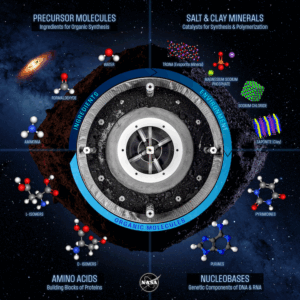
NASA’s robotic Origins, Spectral Interpretation, Resource Identification, Security – Regolith Explorer (“OSIRIS-REx”) steroid sample return mission was designed to gather clues to answering a number of questions central to human experience: Where did we come from? What is our destiny? Asteroids are leftover remnants of the solar system formation process that can help address these questions and inform us about the history of the solar system. OSIRIS-REx was designed and operated by a partnership of science and engineering necessary to overcome the formidable challenges of reaching an asteroid, taking samples there and returning the samples securely and safely to earth. OSIRIS-REx launched in September 2016 and arrived at the asteroid Bennu two years later, in December 2018. After arriving it studied this carbonaceous B-type near-Earth asteroid asteroid and collected >120g of surface rocks. It returned the samples to Earth five years after arriving at Bennu, in September 2023. The samples have been intensely studied by an international science team They have revealed much about the history of the solar system and have provided tantalizing clues to the origin of life in ways, results that could not have been obtained without them. In particular, the samples have provided a pristine record of chemical processes that occurred in the early solar system prior to the origin of life and they have a provided a glimpse into processes that preceded the emergence of life.
Selected Reading & Media References:
(1) Glavin DP, Dworkin JD, et al. 2025. “Abundant ammonia and nitrogen-rich soluble organic matter in samples from asteroid (101955) Bennu.” Nature Astronomy 9, 199–210. doi: 10.1038/s41550-024-02472-9
(2) McCoy TJ, Russell SS, et al. 2025. “An evaporite sequence from ancient brine recorded in Bennu samples.” Nature 637, 1072-1077. doi: 10.1038/s41586-024-08495-6
(3) Lauretta DS, Connolly HC, et al. 2024. “Asteroid (101955) Bennu in the laboratory: Properties of the sample collected by OSIRIS-REx.” Meteoritics & Planetary Science 59, 2453–2486. doi: 10.1111/maps.14227
(4) Lauretta DS et al. 2022. “Spacecraft sample collection and subsurface excavation of asteroid (101955) Bennu.” Science 377, 285–291. doi: 10.1126/science.abm1018
About the Speaker
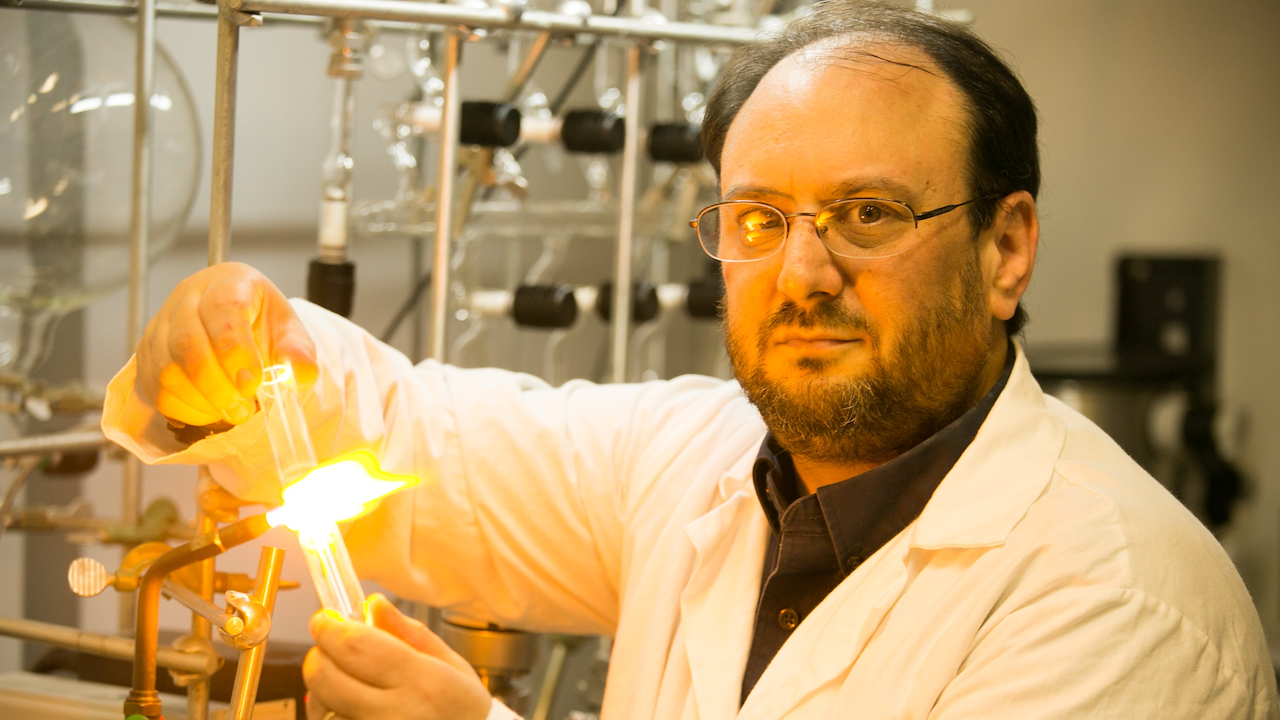
Jason Dworkin is the project scientist for the OSIRIS-REx asteroid sample return mission, and senior scientist for astrobiology at NASA Goddard Space Flight Center (GSFC).
His research is on the organic species that were available for the origin and early evolution of life. He has focused particularly on extraterrestrial inputs and origin of molecules relevant for life. Over the last 40 years, Jason’s focus has been on increasingly documented and constrained systems, from plausibly early Earth chemistry, chemistry of astrophysically relevant laboratory ices, organic and chiral analysis of meteorites, analysis of samples returned from extra-terrestrial bodies, and how to protect that material from contamination. His research employs modern analytical methods to examine authentic samples of the early solar system as well as laboratory models of ancient environments. This involves both directing research in the Astrobiology Analytical Lab at GSFC and scientific leadership in NASA sample return and in situ missions. He has studied soluble organic compounds (with an emphasis on amino acids) formed from laboratory ices simulating astrophysical environments, in sample by returned by JAXA’s Hayabusa and Hayabusa2 missions and those returned by NASA’s Apollo, Stardust, and OSIRIS-REx missions. He is also now a participating scientist on JAXA’s MMX mission to return samples from Phobos and he serves as sample integrity scientist for the Mars Sample Return mission.
Jason is an author on over 190 peer reviewed publications related to astrobiology.
Among other honors and awards Jason has received a NASA Outstanding Leadership Medal, Maryland Chemist of the Year Award, Robert H. Goddard Center Director’s Award, numerous NASA team awards, including NASA Silver Achievement Medals, two Guinness World Records and, most recently, the Michael Collins National Air and Space Museum Trophy for Current Achievement. Asteroid (27347) Dworkin is named in his honor.
Jason earned an AB in Biochemistry at Occidental College and a PhD in Biochemistry UC – San Diego.
Social Media Links:
https://science.gsfc.nasa.gov/sed/bio/jason.p.dworkin
https://science.gsfc.nasa.gov/691/analytical/
http://www.nasa.gov/osiris-rex/
https://www.linkedin.com/in/jasondworkin/
Minutes
On June 27, 2025, Members of the Society and guests joined the speaker for a reception and dinner at 5:45 PM in the Members’ Dining Room at the Cosmos Club. Thereafter they joined other attendees in the Powell Auditorium for the lecture proceedings. In the Powell Auditorium of the Cosmos Club in Washington, D.C., President Larry Millstein called the lecture portion of the 2,518th meeting of the Society to order at 8:05 p.m. ET. He began by welcoming attendees, thanking sponsors for their support, announcing new members, and inviting guests to join the society. Scott Mathews then read the minutes of the previous meeting which included the lecture by Alex Creely, titled “Commercial Fusion Power: High Temperature Superconducting Magnets and Compact Tokamak Power Plants”. The minutes were approved as read.
President Millstein then introduced the speaker for the evening, Jason Dworkin, of the NASA Goddard Space Flight Center. His lecture was titled “OSIRIS-Rex Brings Samples of Bennu to Earth”.
The speaker began by saying that “Rocks remember”, and that Bennu represents the types of materials that bombarded the Earth billions of years ago. He said that rocks from Bennu, additionally, contain information about the processes occurring in the early solar system. Dworkin discussed remote spectroscopy, indicating that while remote measurements can provide several types of information, detailed analysis, particularly with respect to organic molecules, requires physical contact with the sample. The speaker discussed the fact that meteorites provide significant information, but that there are always questions about the provenance, the source, and the possible contamination of samples. Pristine samples must be acquired directly from the source; hence, the need for sample return missions.
The speaker then discussed the history of sample return missions, including: the Apollo moon missions, the NASA Genesis and Stardust missions, JAXA’s Hayabusa and Hayabusa2 missions, and the Tianwen-2 mission. He discussed the goals of the OSIRIS-Rex mission, including: returning a sample of pristine carbonaceous asteroid, providing ground truth for remote observations, asteroid resource identification, security (by better understanding the Yarkovsky effect), and regolith mapping on the sub-cm scale. Dworkin discussed the process by which Bennu was chosen over other candidate asteroids. Bennu turned out to be the only carbon-rich asteroid with a diameter greater than 200 meters, with an optimal orbit for sample return, that had been well-studied with ground-based telescopes.
The speaker then discussed some of the details of the OSIRIS-Rex spacecraft, showing images and animations of: the instrument deck, the actuated solar panels, the sample return capsule, and the sample collection mechanism (or TAGSAM). Dworkin discussed the “Path to Launch”, including the initial proposal, the precursor missions, the construction of the spacecraft, and the launch in September 2016. He mentioned several problems that occurred along the way, including a fire that destroyed critical components, an explosion and fire on a nearby launch pad, the loss of cooling water which jeopardized the spacecraft’s batteries, a forest fire close to the Canberra communication station during approach, and a nation-wide internet outage and a brief failure of the Deep Space Network during critical maneuvers.
Dworkin then discussed some of the details of the OSIRIS-Rex mission, including: launch, outbound cruise, approach, preliminary survey, orbital A, detailed survey, orbitals B & C, rehearsal, sample collection, post-TAG observations, return cruise, and return. He described the imaging of the TAG-site (the sample collection site) and the fact that the spacecraft was able to “TAG” 73 cm from the center of the desired location. He showed 3D images of the collection site, before and after the TAG, indicating that the TAG crater was approximately 9 meters across and 68 cm deep. He showed actual video of the TAGSAM contacting the surface of Bennu, and penetrating about a half meter into the asteroid during sample capture. He showed video of the sample return capsule reentering Earth’s atmosphere and landing safely under parachute in the Utah Desert. Dworkin discussed the processes related to handling the sample return capsule. These included: documenting, bagging, securing, transporting, purging, and finally, opening the capsule. The mission yielded more than 120 gms of pristine regolith, about double the requirement.
The speaker described how the Bennu samples are being distributed amongst several international labs: 14% currently being studied at NASA Goddard, 0.55% being studied at JAXA, 4% to the Canadian Space Agency, and the remainder being stored by NASA’s Johnson Space Center for future study. Dworkin then listed several of the scientific techniques being used to study the Bennu samples, including: FTIR microscopy, gas chromatography, mass spectrometry, isotopic ratio mass spectrometry, SEM and TEM micro-analysis, X-ray absorption spectrometry, etc. He described some of the results of this analysis. These results included: most of the samples are between 1 and 6 billion years old, some the SiC grains pre-date the formation of the solar system, the “precursor asteroid” from which Bennu formed contained large amounts of water, Bennu contains high amounts of ammonia, and all the DNA and RNA nucleobases have been detected.
The speaker ended his talk by saying that even with several disasters and a global pandemic, the launch was on time and under budget, and “It has been a remarkable team.”
The lecture was followed by a Question and Answer session.
A member asked about changes to the samples after collection and return. Dworkin indicated that the pristine, inert storage environment should prevent any significant changes, but that researchers are aware of fractured rocks, where the two pieces fit perfectly together, and it is difficult to determine whether these fractures occurred before collection, during collection, or during the return mission.
A member on the live stream asked why OSIRIS-Rex emphasized the collection of regolith over sub-surface samples. Dworkin responded “Cost”. He explained that drilling down into Bennu would have significantly increased both the risk and the cost of the mission.
A guest asked if there were conditions under which inorganic compounds could have been transformed into organic compounds. Dworkin responded that, to some extent, it depends on how you define organic and inorganic, but that it was not easy and he “wouldn’t bet on it”.
After the question and answer period, President Millstein thanked the speaker and presented him with a PSW rosette, a signed copy of the announcement of his talk, and a signed copy of Volume 17 of the PSW Bulletin. He then announced speakers of up-coming lectures and made a number of housekeeping announcements. He adjourned the 2,518th meeting of the society at 10:04 pm ET.
Temperature in Washington, DC: 25.5° Celsius
Weather: Mostly cloudy
Audience in the Powell auditorium: 97
Viewers on the live stream: 47
For a total of 144 viewers
Views of the video in the first two weeks: 376
Respectfully submitted, Scott Mathews: Recording Secretary