Volcanism and Cryovolcanism Throughout the Solar System
Earth, Io, and Titan
Rosaly M.C. Lopes
Senior Research Scientist
Jet Propulsion Laboratory
About the Lecture
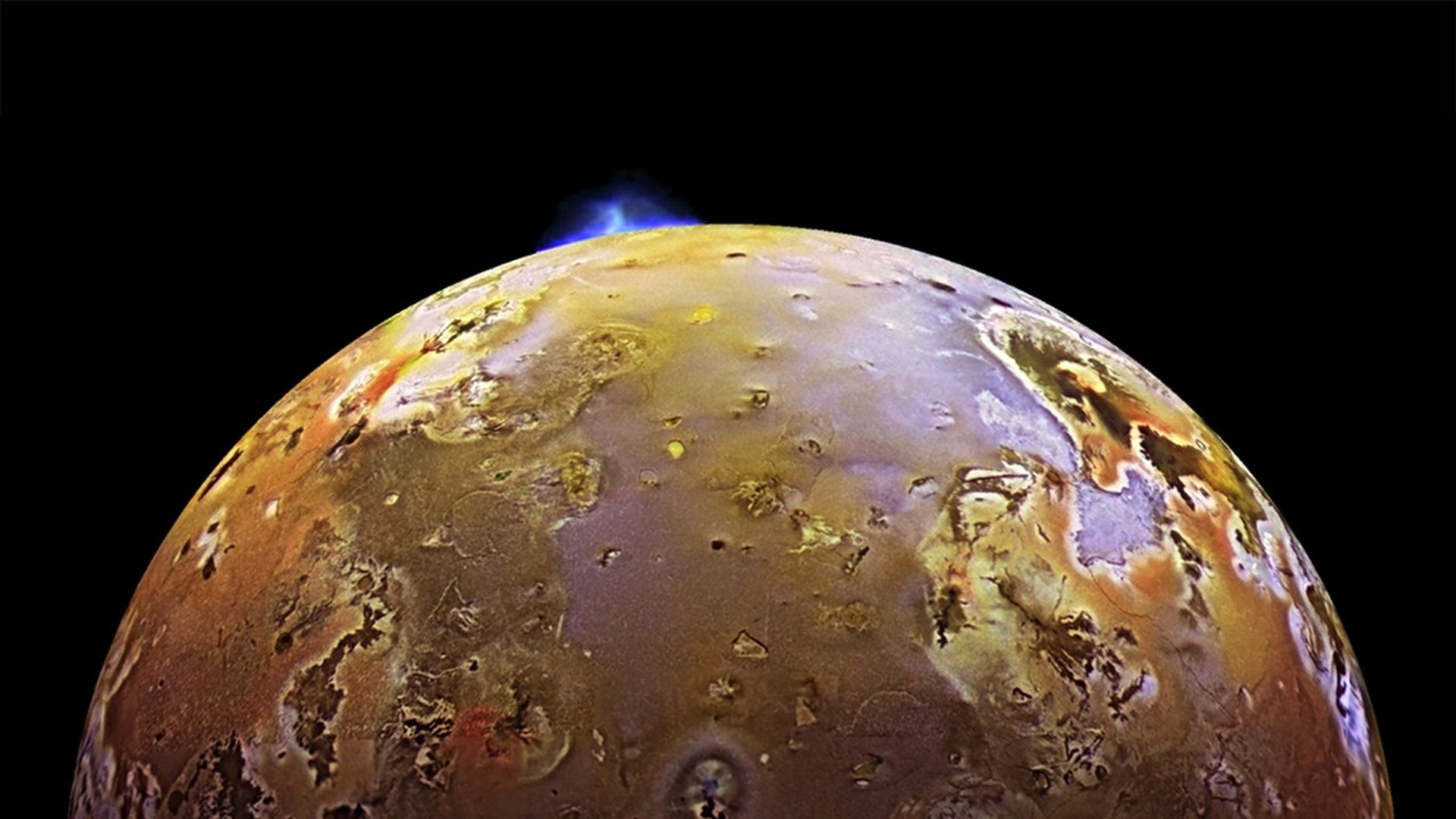
The planets and moons of the Solar System are incredibly diverse worlds with histories both ancient and dramatic. Etched into their surfaces is a fascinating story of fire and ice, of order and upheaval, of slow change and great cataclysms. Volcanoes are common throughout the Solar System and volcanic eruptions are among nature’s most awesome spectacles. On Earth, eruptions range from gentle, beautiful outpourings of lava to catastrophic explosive events. Volcanoes on Earth and other worlds are found in a wide variety of landscapes—even ice volcanoes on the surfaces of icy moons. This lecture will discuss the various types of volcanism and volcanos on Earth and throughout the Solar System, particularly the moons of Jupiter and Saturn. Volcanism may enable habitability, and further exploration of moons such as Europa, Enceladus, and Titan will reveal whether they could have habitable conditions.
Additional Information About the Lecture
Gregg, T.K.P., Lopes, R.M.C., and Fagents, S.A. (Eds): Planetary Volcanism across the Solar System. Comparative Planetology Series, volume 1 (series editors P.K. Byrne, R.M.C. Lopes, and M.A. Siegler). Elsevier, 2021.
S. M. MacKenzie, et al. (2021). Titan: Earth-like on the Outside, Ocean World on the Inside. Plan. Sci. Journ., 2:112 (13pp), https://doi.org/10.3847/PSJ/abf7c9
Lopes, R.M.C., et al. (2010): Beyond Earth: How extra-terrestrial volcanism has changed our definition of a volcano. In: “What’s a volcano? New answers to an old question”. Geological Society of America Special Paper 470 (Eds. E. Canon and A. Szakacs).

About the Speaker

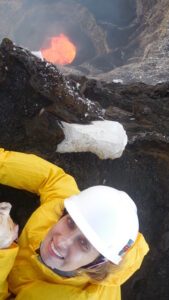
Rosaly M. C. Lopes is a Senior Research Scientist at NASA’s Jet Propulsion Laboratory. She also serves as Adjunct Professor of Astronomy at Cornell University,and Principal Investigator at NASA’s Astrobiology Institute for the project Habitability of Hydrocarbon Worlds: Titan and Beyond. She also previously served as Editor-in-Chief of Icarus, and as President of the Planetary Sciences Section of the American Geophysical Union,
Her major research interests are in planetary and terrestrial geology and volcanology. For more than a decade, she was a member of the Galileo mission team, responsible for observations of Jupiter’s moon Io and its extraordinary volcanic activity using the spacecraft’s Near Infrared Mapping Spectrometer. In the course of her work, she discovered 71 active volcanoes on Io —- the largest number known anywhere in the solar system. This achievement earned her recognition in the Guinness Book of World Records.
Rosaly also contributed to the Cassini mission to Saturn and currently leads an international team studying Cassini data on the geology and potential habitability of Titan as Principal Investigator in NASA’s Astrobiology Institute.
Among her many honors, she is a Fellow of the AAAS, GSA, and AGU; an elected member of the International Academy of Astronautics; and a recipient of two NASA Exceptional Public Service Medals, the Adler Planetarium’s Women in Science Award, the Antarctica Service Medal from the NSF, the Lowell Thomas Medal from the Explorers Club, the Wings WorldQuest Women of Discovery Air and Space Award, and the American Astronomical Society’s Carl Sagan Medal. Asteroid (22454) Rosalylopes has been named in her honor.
She is the author of more than 135 peer-reviewed scientific publications and eight books. She has lectured on her work on every continent—including Antarctica —and has conducted hundreds of interviews, appearing in more than 20 television documentaries.
Rosaly earned a BSc in Astronomy and a PhD in Planetary Science at University College London.
Web and Social Media Resources
Webpage(s):
https://science.nasa.gov/people/rosaly-lopes/
https://explorescientific.com/pages/explore-alliance-ambassadors-dr-rosaly-m-c-lopes
https://volcanoworld.wordpress.com/2011/12/19/rosaly-lopes/
http://science.jpl.nasa.gov/people/Lopes/
LinkedIn: https://www.linkedin.com/in/rosaly-lopes-9395174
X (formerly Twitter): @rosaly_lopes
Facebook: https://www.facebook.com/rosaly.lopes.7
Minutes
On December 5, 2025, Members of the Society and guests joined the speaker for a reception and dinner at 5:45 PM in the Members’ Dining Room at the Cosmos Club. Thereafter they joined other attendees in the Powell Auditorium for the lecture proceedings. In the Powell Auditorium of the Cosmos Club in Washington, D.C., President Larry Millstein called the lecture portion of the 2,526th meeting of the Society to order at 8:02 p.m. ET. He began by welcoming attendees, thanking sponsors for their support, announcing new members, and inviting guests to join the society. Scott Mathews then read the minutes of the previous meeting which included the lecture by Jeffrey Alexander, titled “The Real Returns on Public Research Investments”. The minutes were approved as read.
President Millstein then introduced the speaker for the evening, Rosaly Lopes, of the Jet Propulsion Lab. Her lecture was titled “Volcanism and Cryovolcanism Throughout the Solar System”.
The speaker began by saying that you can’t understand volcanos on other planets if you don’t understand volcanos on Earth. She said that the surfaces of solid planets represent the interplay of the four major geological processes: volcanism, tectonism, impact, and erosion. Lopes showed a map of the Earth, indicating that the vast majority of volcanos occur on tectonic plate boundaries. She listed different types of volcanic activity and the type of landforms they produce: Icelandic & Hawaiian forming fissures & shields, Strombolian, Pelean, & Vulcanian forming cones with mild to moderate explosions; and Plinian & Ultraplinian forming cones with large explosions. She said the type of volcano depended largely on the type of rock, and that the shape of the volcano gives clues about the type of material involved.
Lopes then discussed the surface of the moon, indicating that large, dark areas on the moon (called mare) are the result of lava flows, similar to Icelandic eruptions. She showed images acquired by the Apollo 15 mission which included lava flows, lava channels, and eruption cones & domes. She showed images, acquired by the MESSENGER mission, which indicate pervasive volcanism on the surface of Mercury. The speaker said that impact craters are almost always circular, while volcanic craters are formed by collapse, and are therefore often irregular in shape. The speaker showed images from the surface of Venus, reconstructed from radar data, which indicate the presence of massive volcanos, including lava flows, caldera, and “pancake” domes.
She showed images from the Magellan mission which support the conclusion that active vulcanism on Venus has occurred as recently as the 1990’s.
The speaker showed topographic images of the surface of Mars, saying that Mars has the largest volcanos in the solar system, including Olympus Mons which is 26 km high and about 600 km in diameter. She discussed the possibility that an eruption of Olympus Mons could have melted Martian permafrost, creating flash floods and landslides, the remnants of which are visible in the topographic data. The speaker showed images from the Curiosity rover which indicated the presence of “Clasts of Elemental Sulfur”, consistent with volcanic sulfur observed on Earth.
The speaker then discussed “Cryovulcanism”: essentially, vulcanism where the erupting material is not molten rock, but primarily water, with other components. She showed images of a suspected cryovolcano on Ceres, a dwarf planet in the main asteroid belt, with a layer of liquid water under its crust. Lopes showed several images of Io, one of Jupiter’s moons, claiming that it was the most volcanically active body in the solar system, with at least 174 active volcanos and hundreds of inactive volcanic features. Some of these images showed volcanic plumes rising hundreds of kilometers above Io’s surface. She described the gravitational process by which Jupiter’s other moons would create tidal forces on Io, supplying enough energy to keep Io’s core molten and drive volcanic activity. Lopes showed thermal images of Io, acquired by the Galileo mission, using the Near-Infrared Mapping Spectrometer (or NIMS). She said that more recent analysis of the NIMS data allowed her to confirm the presence of more than 300 active volcanos on Io, although the 2006 edition of Guinness Book of World Records, which acknowledges her as the record holder, credits her with discovering a mere 71 active volcanos. Lopes described the types of volcanic activity observed on Io: Lokian (lava lakes or flooded calderas), Promethean (long duration lava flows), Pillanian (explosion dominated events), and two other, rarer types which are possibly sulfur and silicon dioxide flows. She showed images acquired from the Juno mission in 2024, which clearly indicated the presence of “hot rings” associated with lava lakes, indicating that lava lakes were the most common form of volcanism on Io. For comparison, Lopes showed a number of images and videos of lava lakes on Earth, all of which she personally visited.
The speaker discussed cryovolcanism on Jupiter’s icy moon Europa. It is widely believed that Europa has liquid water oceans, below its icy crust, which could potentially support extraterrestrial life. Lopes showed images of plumes ejected from the surface of Europa, presumably due to cryovolcanoes. She indicated that the Europa Clipper mission, which launched in 2024, could confirm this hypothesis when it reaches Europa in 2030. Lopes showed images of Enceladus, one of Saturn’s icy moons, also believed to harbor a liquid water ocean. These images, acquired by the Cassini mission, show massive cracks in the icy surface, and geyser-like jets of water vapor, molecular hydrogen, and other volatile compounds. The speaker showed possible evidence of cryovolcanism on Titan, another one of Saturn’s moons. Radar data from Cassini indicates the presence of a crater, about 1 km deep, in close proximity to a peak, about 1 km tall; structures that are commonly associated with volcanic activity. Showing images from the New Horizons mission, the speaker speculated about the presence of cryovolcanos on Pluto.
The speaker ended her talk by discussing the possibility of volcanic activity on exoplanets, saying that a sodium cloud, consistent with volcanic activity, has been observed near an exomoon orbiting WASP-49B.
The lecture was followed by a Question and Answer session.
A member asked how Lopez became interested in planetary physics as a little girl or a young lady. Lopez responded that she grew-up hearing about the Apollo missions, and wanted to be an astronaut. But given her very poor eyesight, she thought her chances in the space program were slim, so she decided to study astronomy. She said she was inspired by Francis “Poppy” Northcott, one of the few women working in Mission Control during the Apollo missions.
A member asked if cryovolcanos could exist in close proximity to magma volcanos, and if so, could an eruption of one trigger the other. Lopes responded that although this situation has not been definitively observed, it is a real possibility and that some features on Io could potentially be explained by such proximity.
A member on the live stream asked if Lopes had any thoughts about heat sources driving cryovolcanism on Pluto. Lopes responded that the energy source was very likely tidal in nature.
After the question and answer period, President Millstein thanked the speaker and presented her with a PSW rosette, a signed copy of the announcement of her talk, and a signed copy of Volume 17 of the PSW Bulletin. He then announced speakers of up-coming lectures and made a number of housekeeping announcements. He adjourned the 2,526th meeting of the society at 9:59 pm ET.
Temperature in Washington, DC: -2.8° Celsius
Weather: Cloudy
Audience in the Powell auditorium: 71
Viewers on the live stream: 28
For a total of 99 viewers
Views of the video in the first two weeks: 314
Respectfully submitted, Scott Mathews: Recording Secretary