Measuring the Emptiness of a Vacuum
Stephen Eckel
Group Leader, Fundamental Thermodynamics Group
Sensor Sciences Division
NIST
Sponsored by PSW Science Member Charles Clark
About the Lecture
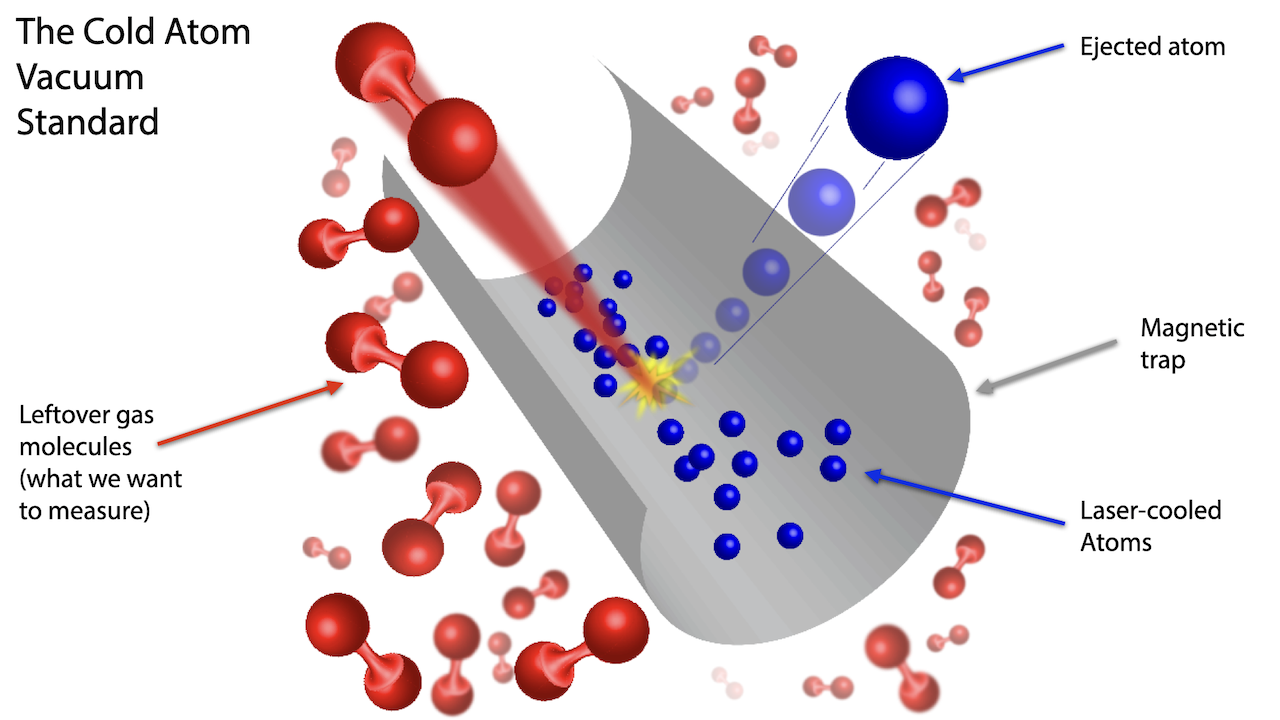
From the tiniest semiconductors manufactured to underpin the AI revolution to the detection of ripples of spacetime due to coalescing black holes, modern technologies and discoveries rely on some of the purest vacuums obtainable on Earth. These vacuums are so pure, that for every gas molecule left behind in the vacuum chamber, roughly 100 billion have been removed. At such ultra-high vacuum pressures, the current best way to measure pressure is the so-called ionization gauge, invented during the vacuum tube era. Unreliable and inaccurate at best, ionization gauges require constant recalibration to be used in any application requiring even modest accuracy.
At NIST, we are endeavoring to change the way vacuum is measured in the ultra-high and extreme-high vacuum regimes by utilizing techniques from modern atomic physics. Our technique requires laser cooling and trapping clouds of roughly 100,000 lithium or rubidium atoms and suspending them in a trap formed by magnetic fields within the vacuum chamber whose pressure we wish to measure. The atom clouds are cold, roughly 100 millionths of a degree above absolute zero, and the traps holding them are just strong enough to confine these barely moving atoms. If a left-behind gas molecule bouncing around the vacuum chamber strikes one of the laser-cooled atoms, it will, with near unity probability, eject the atom from the trap. Thus, one can use the measured loss rate of atoms from the trap together with the calculated cross-section for a collision to extract the vacuum pressure.
Over the last decade, we have built several devices – called cold-atom vacuum standards (CAVSs) – based on this measurement principle. In the last several years, we have verified the technique and the quantum mechanical calculations that underpin it using laboratory-scale devices. In parallel, we also developed a version that can act as a replacement for the crude ionization gauges used today, which we call the portable cold-atom vacuum standard (p-CAVS). As we look toward the future, we continue to refine our prototype p-CAVS, so that it can be used in industry and science as a drop-in replacement for ionization gauges and be ready to deliver the accuracy needed for when the next generation of advanced manufacturing or big science experiments requires even better vacuums.
Selected Reading & Media References
Popular Science (https://www.popsci.com/science/vacuum-measurements-manufacturing-new-method/)
Popular Mechanics (https://www.popularmechanics.com/science/a44904905/new-way-to-measure-nothing/)
Physics World (https://physicsworld.com/a/cold-atoms-used-to-create-reliable-pressure-gauge-for-ultra-high-vacuum/)
IEEE Spectrum (https://spectrum.ieee.org/vacuum-measurement)
NIST press releases:
https://www.nist.gov/news-events/news/2023/08/nist-demonstrates-new-primary-standard-measuring-ultralow-pressures
https://www.nist.gov/news-events/news/2022/07/primary-standard-measuring-vacuum
About the Speaker
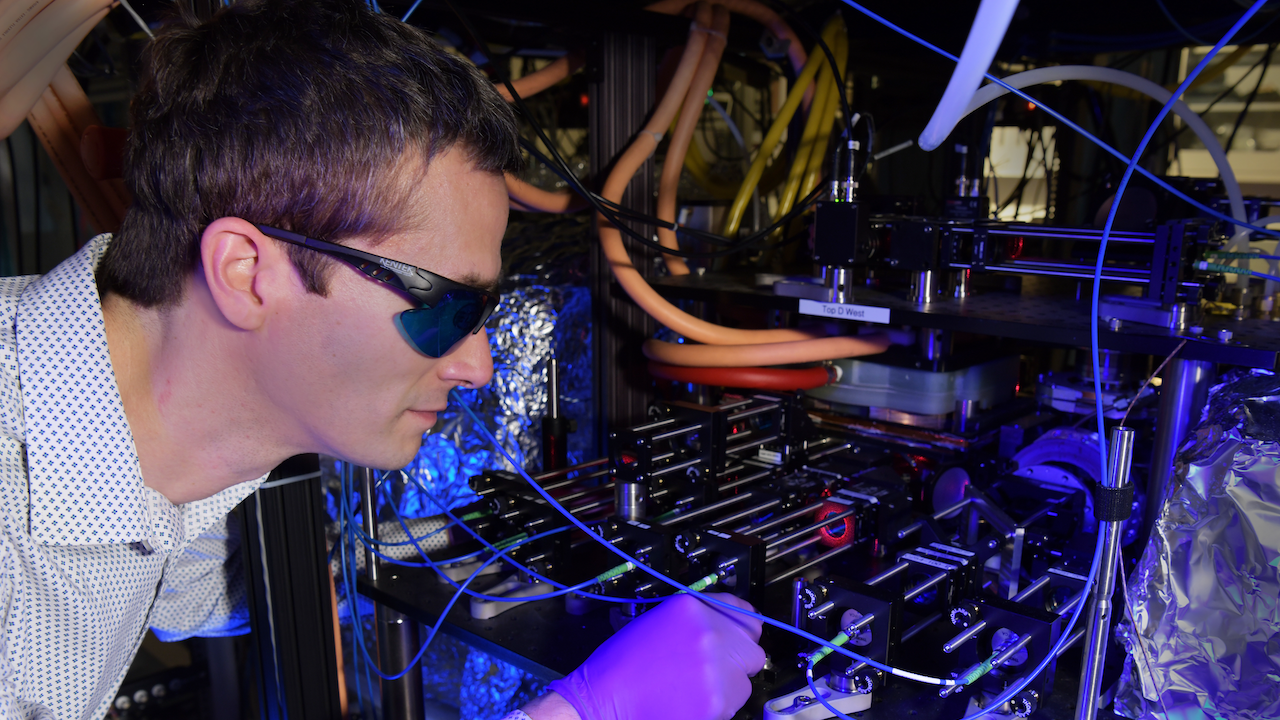
Stephen Eckel is the Group Leader of the Fundamental Thermodynamics Group at the National Institute of Standards and Technology (NIST). Previously at NIST he served as research physicist developing quantum-based, cold-atom measurement standards.
Stephen’s research centers on cold-atom sensing and precision measurement, particularly the use of atoms and molecules to create calibration-free sensors for pressure/vacuum and temperature. A major focus of his work is translating quantum systems—laser-cooled atoms, atom–molecule interactions, and precision spectroscopy—into practical metrology tools that can function as primary standards and deployable instruments.
He was a member of the team that developed the cold atom vacuum standard, currently the only primary standard of vacuum pressure in the ultra-high and extreme-high vacuum regimes. And Stephen and collaborators demonstrated the portable Cold Atom Vacuum Standard (pCAVS), a first-of-its-kind absolute vacuum standard and quantum-mechanical vacuum pressure sensor.
Stephen is an author on more than 56 scientific and technical publications and an inventor in six patent applications and patents.
Among other honors and awards, Stephen is a recipient of the Presidential Early Career Award for Scientists and Engineers, a Department of Commerce Bronze Medal for the pCAVS demonstration, and the Physical Measurement Laboratory’s Scientific Leadership Award.
He earned a B.S. in Physics at Lehigh University and a Ph.D. in Physics at Yale.
Google Scholar: https://scholar.google.com/citations?hl=en&user=WrHKnoAAAAAJ
ResearchGate: https://www.researchgate.net/profile/Stephen-Eckel?ev=prf_overview
Webpage(s): https://www.nist.gov/people/stephen-eckel
Minutes
On February 6, 2026, Members of the Society and guests joined the speaker for a reception and dinner at 5:45 PM in the Members’ Dining Room at the Cosmos Club. Thereafter they joined other attendees in the Powell Auditorium for the lecture proceedings. In the Powell Auditorium of the Cosmos Club in Washington, D.C., President Larry Millstein called the lecture portion of the 2,530th meeting of the Society to order at 8:02 p.m. ET. He began by welcoming attendees, thanking sponsors for their support, announcing new members, and inviting guests to join the society. Scott Mathews then read the minutes of the previous meeting which included the lecture by Gordon Guyatt, titled “Evidence-Based Medicine & the GRADE Framework”. The minutes were approved as read.
President Millstein then introduced the speaker for the evening, Stephen Eckel, of NIST. His lecture was titled “Measuring the Emptiness of a Vacuum”.
The speaker began by discussing a 1908 Stanley Steam Car, saying that steam engines were responsible for the development of thermodynamics. He described the standardization of automobile parts which occurred at the beginning of the 20th century, and required precision measurements using gauge blocks. Eckel claimed that measurement technology necessarily preceded the fabrication technology. He then described a modern, extreme Ultra-violet lithography machine, used to fabricate modern semiconductor devices. The extreme ultra-violet light used in these machines does not propagate through air, and therefore requires high vacuum. He described the two LIGO machines, used to detect gravity waves, saying that these instruments also require very high vacuum to operate.
The speaker then discussed modern methods for quantifying vacuum, specifically in terms of the “Système International” or SI units. He described how NIST has redefined the unit of pressure, the Pascal, in terms of fundamental constants. The Pascal can be expressed as a Joule per meter cubed, which can be expressed in terms of the Kelvin and the second: two quantities that are tracible to fundamental constants. Eckel showed a graph, ranging from 109 Pa to 10-12 Pa, indicating where such vacuum levels could be found: Earth’s atmosphere at about 105 Pa, high vacuum for vacuum tubes and traditional semiconductor processing between 10-3 and 10-6 Pa, ultra-high vacuum for EUV lithography and particle accelerators from 10-6 to 10-9 Pa, and extreme high vacuum found in deep space and used for quantum computers below 10-9 Pa.
Eckel discussed two different techniques for measuring pressure, currently being developed at NIST. The first is based on measuring gas density via index of refraction. He described using two Fabry-Perot cavities, one containing the gas to be measured, the other an empty reference cell. By measuring the change in the resonant frequency, the index of refraction of the gas can be measured, determining its pressure. The speaker claimed that this type of gauge could replace standard gauges in the range from 106 Pa down to about 10-5 Pa, the lower end of the “high vacuum” range.
The second technique being developed by NIST, applicable to much lower pressures, is based on the “cold atom vacuum standard” or CAVS. The speaker said that this technique involves laser cooling 7Li (lithium-7) atoms to about 100 μK, and trapping those atoms in a magnetic field. When the gas molecules of the “background gas” strike the cold atoms, the cold atoms are ejected from the magnetic trap with near unity probability. By measuring the rate at which cold atoms are ejected from the trap, the pressure of the background gas can be determined. Eckel said that quantum mechanical calculations provide very accurate estimates for the loss rate coefficient of the cold atom trap. Because the measurement of loss rate is defined by the second, and the conversion to pressure requires the Kelvin, this constitutes a “primary standard”: a standard that is tracible to fundamental constants, and does not rely on any other measurement of pressure.
The speaker described the process of laser cooling, developed at NIST Boulder in the early 1980’s. This process is based on momentum transfer to gas molecules by resonant absorption of photons, modified by the Doppler effect. It allows the cooling of gas molecules in a magneto-optical trap down to the microkelvin range. Eckel showed diagrams and pictures of a laboratory CAVS system, including the vacuum chamber, the atom source, the 2D magneto optical trap, the 3D magneto optical trap, and the cooling laser beams. He showed an image of approximately 1 million 7Li atoms, laser cooled to 300 μK in the laboratory CAVS system. The speaker then showed diagrams of the portable CAVS system, or p-CAVS, meant to replace ion gauges. He described how a custom-made diffraction grating allows the six laser beams of the laboratory CAVS to be replaced by a single beam. He described the process by which the lithium atoms are loaded into the magneto optical trap, laser cooled, ejected by collisions with the background gas, and repeatedly measured as a function of time. Eckels described early discrepancies that were observed between two, ostensibly identical p-CAVS, yielding two different pressures, which were eventually traced to a leak in one system.
The speaker ended his talk by acknowledging his collaborators and saying “None of this work happens in a vacuum.”
The lecture was followed by a Question and Answer session.
A member asked about the units used to quantify pressure or vacuum, saying that MBE machines routinely create pressures of 1010. Eckel responded that many vacuum systems report pressure in Torr, not in Pascals, and that the Pascal is approximately two orders of magnitude smaller than the Torr.
A member asked why one of the mirrors in the Fabry-Perot cavity was curved. Eckel responded that if both surfaces were flat, any misalignment would cause the laser beam to “wander out” of the cavity after a few round-trips. Having one curved mirror ensures that light stays in the cavity for a longer time.
A member on the live stream asked if it was possible to reach a temperature of absolute zero, and if so, what would it look like. Eckel responded that reaching absolute zero, in a finite number of steps, was forbidden by the Third Law of Thermodynamics. He said that as you approach absolute zero, you see the gas atoms moving even more slowly. Because these are very dilute gases, they never condense or form a different state of matter.
After the question and answer period, President Millstein thanked the speaker and presented him with a PSW rosette, a signed copy of the announcement of his talk, and a signed copy of Volume 17 of the PSW Bulletin. He then announced speakers of up-coming lectures and made a number of housekeeping announcements. He adjourned the 2,530th meeting of the society at 9:58 pm ET.
Temperature in Washington, DC: -0.6° Celsius
Weather: Cloudy
Dinner Attendance: 33
Audience in the Powell auditorium: 45
Viewers on the live stream: 26
For a total of 71 viewers
Views of the video in the first two weeks: 459
Respectfully submitted,
Scott Mathews
Recording Secretary