AI-Enabled Radio-Frequency Chip Design
Beyond Human Intuition
Kaushik Sengupta
Professor of Electrical and Computer Engineering
Director, Integrated Micro-systems Research Laboratory
Co-Director, Princeton NextG
Princeton University
Sponsored by PSW Science Member Eugene Okwodu
Video
About the Lecture
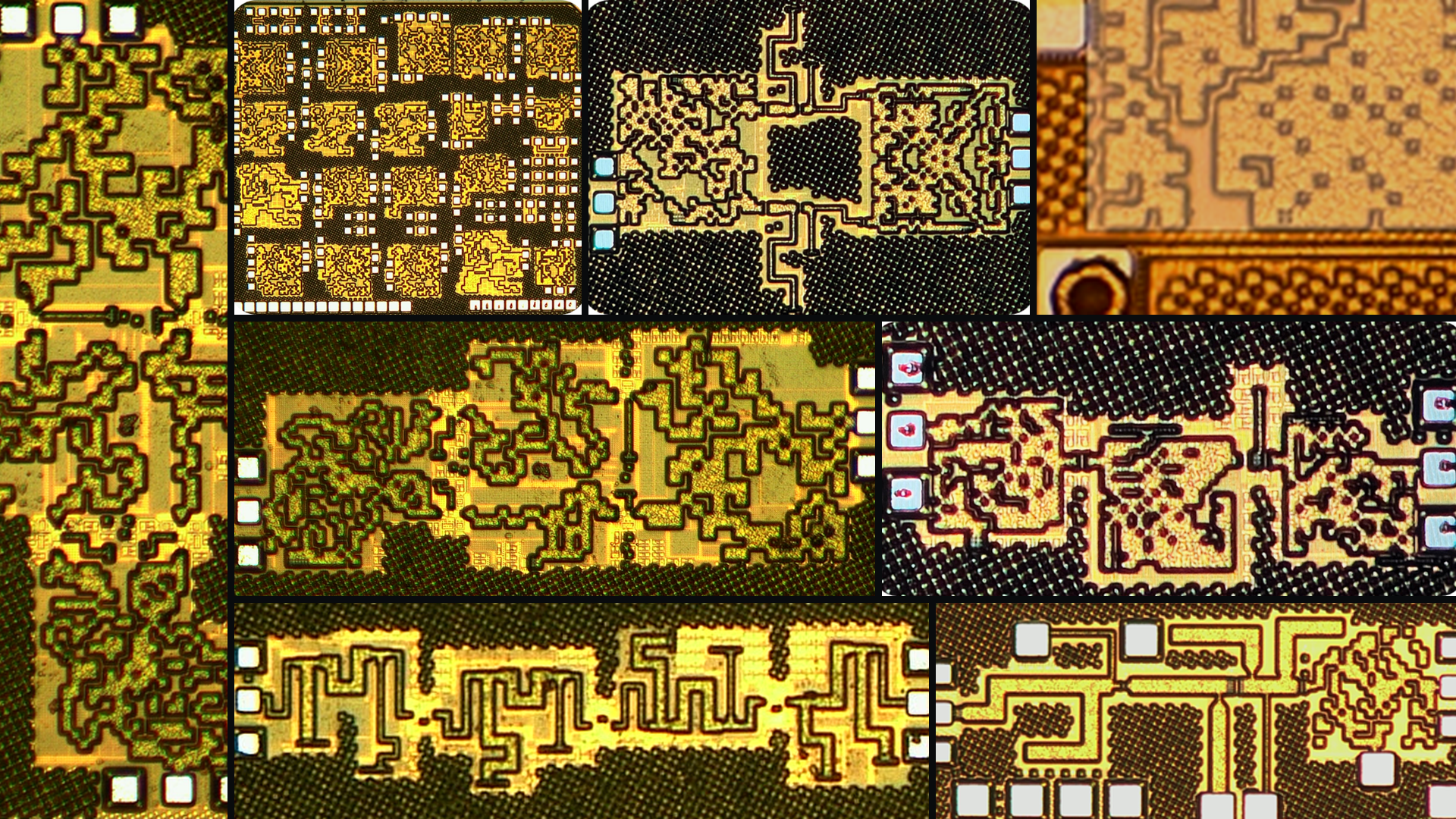
For most of engineering history, complex systems have been built from simpler structures that we already understand. Bridges begin with familiar structural forms; circuits with known topologies; chips with established devices and building blocks. This hierarchical approach is what makes complexity manageable. But it also raises a deeper question: how much of the design space do we never explore simply because we have chosen representations that are convenient for humans?
What lies outside those familiar architectures? Are there useful physical structures that obey all the same laws of mechanics, electromagnetics, and thermodynamics, but would be unlikely to emerge from conventional design practice? And can artificial intelligence help us find them and expand what is possible?
Radio-frequency integrated circuits provide a particularly demanding test case. Sixty years of Moore’s law have given us a society in which wireless underpins everything: thousands of these chips can now be integrated into a single panel, driving thousands of antennas in unison, tracking a satellite crossing the sky at 27,000 kilometres an hour. That capability underpins satellite communications, 6G, autonomous cars, robotics and sensing, and every bit of it is won through painful multiphysics design, in which device physics, electromagnetic fields, thermal behavior and packaging geometry are all tightly coupled. The consequence is that design still rests on templates, intuition and hard-won expertise: costs that can run past $100 million dollars, design times of months to years, and a design space that stays relatively small.
This lecture will explore whether AI can transform those design spaces and what they make possible. Starting from desired physical behavior, we will examine how learned models and inverse design can open new design spaces. Using RF chips as a case study, I will discuss what these methods can genuinely achieve, how their results are tested through simulation and silicon measurement, where they fail, and whether they can reach past human intuition to uncover new physical design principles.
Reading & Media References
IEEE Spectrum: https://spectrum.ieee.org/ai-radio-chip-design
Nature comm: https://www.nature.com/articles/s41467-024-54178-1
Princeton press releases:
https://ece.princeton.edu/news/ai-slashes-cost-and-time-chip-design-not-all
https://engineering.princeton.edu/news/2025/06/02/princeton-will-lead-u-s-effort-design-better-chips-wireless-communication
Global Foundries press release:
https://gf.com/news-and-events/blog/designing-the-future-ai-innovation-accelerated-through-university-collaboration/
About the Speaker
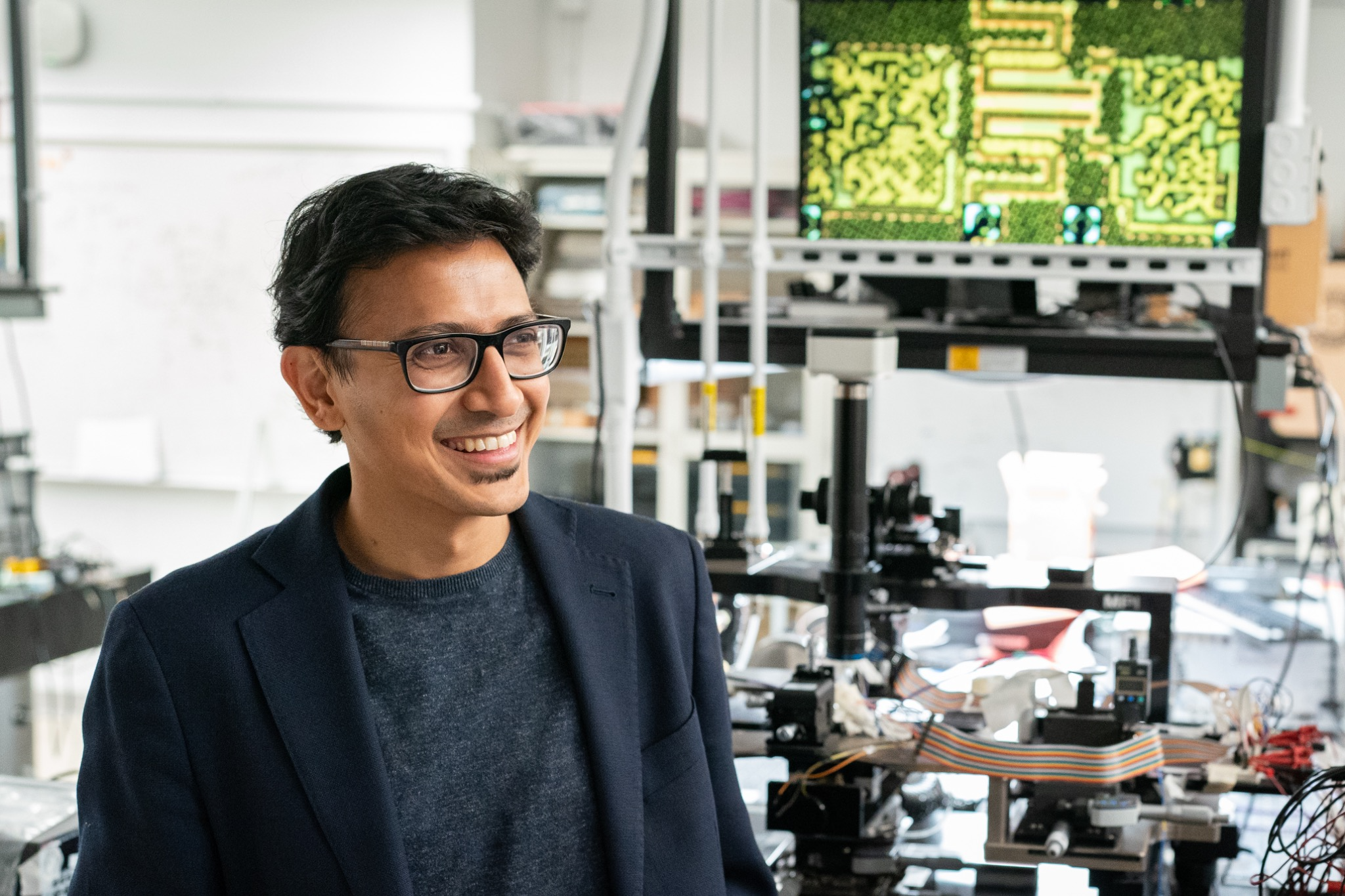
Kaushik Sengupta is Professor of Electrical and Computer Engineering at Princeton University, where he directs the Integrated Microsystems Research Lab and is a director and co-founder of Princeton’s NextG Initiative in advanced communications technology.
His research focuses on integrated circuits and systems for communication, sensing, and imaging across millimeter-wave, terahertz, and optical frequencies. His group combines electromagnetic physics, circuit and antenna design, signal processing, and machine learning to create chip-scale systems that operate beyond conventional performance tradeoffs. The work increasingly explores how artificial intelligence, computation, and physics can be combined to discover structures and architectures that are difficult to reach through conventional engineering intuition.
Kaushik’s laboratory has demonstrated silicon terahertz sources and arrays, programmable terahertz holographic metasurfaces, physical-layer secure wireless links, nano-optical chips for biomolecular sensing, and AI-based methods for inverse design of radio-frequency and millimeter-wave components. His group has pioneered generative-AI and reinforcement-learning-based approaches to end-to-end RF integrated-circuit design that jointly explore circuit and electromagnetic design spaces beyond conventional human-selected topologies. Its AI-driven chip-design work has shown that specialized RF circuits that traditionally require weeks of expert design can be synthesized in hours using AI. His research also contributed to the founding of Guru Inc., a California company developing long-distance wireless power transmission, for which he has served as an adviser.
Kaushik is an author on more than 170 scholarly publications and conference contributions and is co-editor of RF and mm-Wave Power Generation in Silicon. He has also served as a Distinguished Lecturer for both the IEEE Solid-State Circuits Society and the IEEE Microwave Theory and Technology Society. In addition, he is named as an inventor on more than 30 patents and patent applications.
Among other honors and awards, Kaushik is a Fellow of the IEEE and has received the IEEE Solid-State Circuits Society New Frontier Award, the IEEE Microwave Theory and Technology Society Outstanding Young Engineer Award, the IEEE Microwave Prize, the IEEE Journal of Solid-State Circuits Best Paper of the Year Award, the DARPA Young Faculty Award, the Office of Naval Research Young Investigator Award, and the Bell Labs Prize.
Kaushik earned a dual BTech and MTech in Electronics and Electrical Communication Engineering at the Indian Institute of Technology Kharagpur, and an MS and PhD in Electrical Engineering at the California Institute of Technology.
Readings about the Speaker
Princeton Engineering faculty profile: https://engineering.princeton.edu/faculty/kaushik-sengupta
Princeton IEEE Fellow profile: https://engineering.princeton.edu/news/2025/01/21/kaushik-sengupta-named-ieee-fellow
Princeton research profile: https://collaborate.princeton.edu/en/persons/kaushik-sengupta/
LinkedIn Profile: https://www.linkedin.com/in/kaushik-sengupta-4960a57/